The Kayak Cup HolderBy Steadi Labs

A base for the floor of the boat

You drink when you stop paddling.

Drifting a bank. Anchored over a flat. Beached on a sandbar with your feet in the water. Sitting at the put-in with the skirt off, before anybody has gone anywhere. That is when the bottle comes out — and that stopped, settled boat is the only thing this page is about.

Your kayak gives an accessory five things to hold on to: a gear track, a moulded mount recess, a clampable rail, a scupper, a cockpit coaming. Plenty of boats have none of them. Every boat has a floor.

4.9 average · 120 reviews

See the packs

from $14.95 · free shipping on every order

Ships from Orange, California. 90 days to change your mind, used is fine.

A can standing in a white Steadi base on the ribbed plastic bed liner of a pickup truck, tailgate down.
White, on a ribbed bed liner with the tailgate down. Hard textured plastic, which is what a deck is too. Twelve colours in all.

Read this before you buy anything

“No drilling required” means “no drilling, given a track.”

Search kayak cup holder and almost every result assumes something about your boat that it does not say on the first line. Below are three of them in their sellers’ own words, looked up on 2 September 2026. Read the middle column first.

Track mount

Gear track

a T-slot in the deck

RAILBLAZA’s DrinkHold advertises “zero drilling” and “toolless installation” and “installs in seconds with the included track adaptor.” All true. All of it starts with a track.

Rail clamp

Factory rail

an H-Rail, so: a Hobie

Hobie sells an H-Rail Cup Holder among its H-Rail accessories, and the mounting plate goes on and off without tools. The rail is the product you already bought with the boat.

Coaming clip

20 oz

a rim, and a small bottle

Cascade Creek lists the Yakuzzi as “no tools needed,” “no holes to drill,” “two second installation” — and “holds up to 20oz. bottle.” That last line is the whole story for anyone carrying a 40 oz tumbler.

Or the floor

$14.95

nothing at all

A 5.2″ moulded base, 3.6 ounces, that the drink stands in. It asks the boat for a flat spot and nothing else, which is the one thing every hull in the parking lot has.

The other two interfaces are the same story with different hardware. A moulded mount recess — Perception calls theirs a Solo Mount — is factory-fitted or it is not there. A scupper is sit-on-top only and is not a standard size: YakAttack’s universal scupper plugs cover holes “ranging from 1.13" to 1.40" in diameter” in the small/medium size alone, with a separate medium/large for the bigger ones, and one boat can have both. Crescent’s Scupholder, built around a YakAttack MultiMount, is listed as fitting a specific handful of Crescent models. Everything else on the hull is bare rotomoulded skin.

Sellers’ own published copy and specifications: railblaza.com · hobie.com · blackhallmarina.com (Hobie H-Rail mounting plate listing) · cascadecreek.com · yakattack.us · crescentkayaks.com · kayakanglermag.com. All fetched 2 September 2026 and quoted as published.


What the floor is actually doing wrong

The bottle does not mind the water. It minds being round.

  • A lidded bottle does not care about a wet footwell

    On a self-bailing hull the water is going to be there whether your drink is or not — that is what the scuppers are for. Paddlers reject the floor for the wrong reason.

  • It rolls because it is round

    A round thing on a smooth wet floor goes as soon as the boat leans, usually ending up behind the foot pegs where you cannot get it without stopping. That is a footprint problem, not a mounting problem.

  • Suction is the failure most paddlers here already own

    SnapIt! Products, which sells no-drill boat holders, names the surfaces suction actually needs: “acrylic windscreens, gelcoated console dashboards, or flat cockpit panels,” kept “impeccably clean and dry” and alcohol-wiped of “wax, salt residue, or dirt” — and SnapIt warns that reliability “can be affected by extreme temperature changes, dirt, or textured surfaces.” A rotomoulded deck is textured, crowned and wet by design. If yours let go, you were not unlucky.

  • The tankwell is the most secure spot and the worst one

    It is behind the seat, usually under the crate, and reaching it means the full torso rotation a narrow hull reacts to. Same for the bow bungees past the front hatch. Rank a spot by reach first, then ask what will hold something there.

  • Drilling is fine. It is just rarely right for a cup

    Well nuts seal a bolt hole properly and are, by the standard description of the fastener, “not particularly strong” — which is fine for light gear. The problem is permanence: flush mounting means “a two-inch hole saw,” and Kayak Angler notes that “cutting a large hole in the kayak is hard to repair.” Worth it for a rod holder you will troll with for a decade. Not for a drink.

Quoted as published: snapitproducts.com · kayakanglermag.com · en.wikipedia.org (well nut). Fetched 2 September 2026.

The footwell is the one surface not already doing a job

The tankwell holds the crate. The bungees hold gear. The coaming holds the skirt. The tracks hold the rod holders you actually care about.

The floor holds nothing. It is low, flat, solid polyethylene, walled on both sides by the hull, well below the rail and squarely inside the arc you can reach one-handed with the paddle still across the cockpit.

So the question changes

Not “what can I bolt to this boat.” It is “how do I give this container a wider foot than the factory gave it.” A koozie on a bare can is the same idea; most paddlers worked that out on their own years ago.

Does it actually work

It wobbles. Then it settles.

Something shoves the surface beside it and the drink comes back level instead of going over. The base is 5.2 inches across and the whole thing has to lean a long way before it passes outside that footprint.

Filmed on a couch cushion, not in a boat. It is the footage we have, and a cushion is the softer, worse case — a footwell floor is hard flat plastic, which is the easier one. What this does not show is a kayak, and it does not show a boat under way. We are not going to dress it up as a lake. The limits are written out below.

A full can standing in a white Steadi on a couch cushion, a living room behind it.
Real footage, one take, no cuts.

How it holds

Width, and nothing else.

The foot

5.2 inches across, and fixed — it does not expand, contract or deform. That moves the edge the drink would have to tip over much further out than the container’s own bottom, so it has to lean much further before it goes.

The fins

Six of them, gripping the bottom inch. Cans and bottles slide on over the top; glasses and tumblers drop in through the fins. Drink and base then move as one piece rather than two.

The rolling problem, solved by geometry

A round bottle rolls the moment the deck leans. A 5.2-inch flat foot does not roll, because it is not round. That is the whole trick and there is nothing else in it.

What it is not doing

Nothing is stuck down. No suction, no clamp, no strap, no cord, no bolt. It stands there under its own width and lifts straight off with one hand.

A macro photograph of the flared foot of a terracotta Steadi, showing the moulded STEADI mark.
The flare, close. That width is the entire mechanism.

See the packs — from $14.95

The object

One piece of moulded rubber. No hardware, no instructions.

There is nothing to rig, nothing to torque to spec and nothing to leave behind on the boat. It goes down on the floor, the drink goes in it, and at the take-out it comes out with the dry bag and rides home in the truck cup holder. It moves between hulls — including a rental you have never seen before — in one motion, with no tools in the picture.

  • Foot5.2″ — fixed
  • Height2.8″
  • Opening at rest1.64″
  • Weightabout 3.6 oz
  • Fins6, from 0.92″ up, flexing to 3.15″
  • MaterialShore 85A TPU
  • Track or rail requiredNone
  • HardwareNone
  • BuoyancyNone — it sinks
  • CleaningRinse, wipe, or dishwasher
A hand carrying a can with a terracotta Steadi base still gripped on the bottom of it.
Drink and base, lifted as one piece. That is also how it leaves the boat.

What seats and what does not

Measure the bottom inch. Ounces tell you nothing.

Every fit argument in this category is really about the diameter of the base, and the numbers are not intuitive. A standard 12 oz can is 2.6 inches at the widest point of the body — the narrowest thing you will bring aboard. A Stanley 40 oz Quencher is about 3.1 inches and seats snug, because it was designed narrow enough for a truck cup holder. A 32 oz wide-mouth Nalgene is 3.5 inches by Nalgene’s own spec, and that is an honest no — it is past what the fins flex to. If the Nalgene is your bottle, buy a track holder: YakAttack’s MultiMount copy names Nalgene bottles outright.

Search by container

Every width below comes from a published specification, not from us. Where a spec is uncertain, the answer says so.

Or the width across the bottom

A width across the bottom of the bottle, in inches.

Six cans of different diameters, from a slim can to a stovepipe, each standing in a terracotta Steadi base.
Slim, standard, tallboy, stovepipe. The bottom inch is the only measurement that matters.

The tailgate test, before the boat goes in

A standard sticky note is three inches square. Stand your bottle on one on the tailgate. Base inside the paper, it seats. Base overhanging the paper, do not order on hope — that is the whole test, and it takes ten seconds at the truck instead of a discovery at mile two.

Anything borderline — hello@steadilabs.com reaches a person, and the answer will be honest either way, including a no.

Where they end up

The footwell, the tailgate, the cooler lid at the take-out.

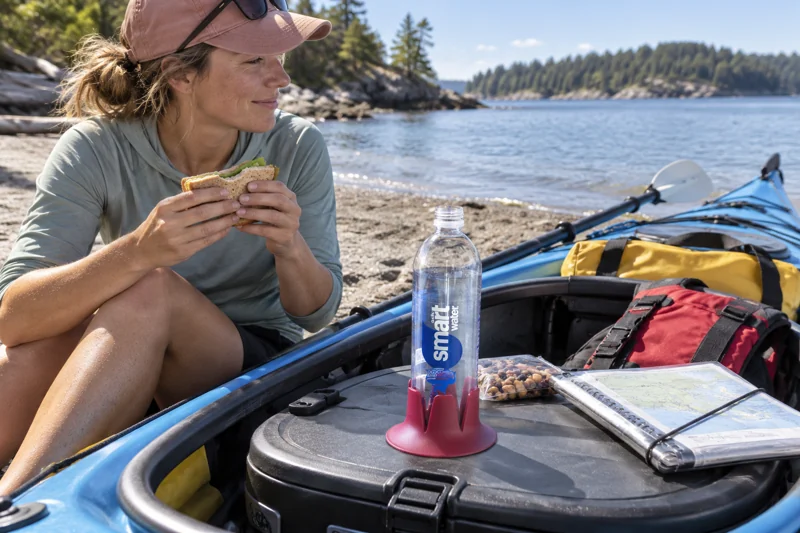
Low and inside the hull is where this belongs: in the footwell between your feet on a sit-inside, or on the flat of the deck in front of the seat on a sit-on-top, where you can reach it one-handed with the paddle still across the cockpit. Not on the front deck, not on the rail, and not anywhere it can go over the side.

The rest of the day it earns its keep on hard flat surfaces that were never going to hold a drink either — the tailgate at the ramp, the cooler lid, the picnic table at the take-out, the truck cup holder on the drive home. It goes in the dry bag between all of them.

Twelve colours, and the picker assigns one per unit, which is the fastest way to stop arguing about whose bottle is whose when three boats come off the roof at once.


What the aisle asks of your boat

Every one of them is a fit question about your exact hull. Except one.

These are the sellers’ own published requirements and their own published copy, looked up on 2 September 2026 and quoted rather than summarised. No prices are shown for the other rows: we did not capture them, and a price we cannot source does not belong on this page.

The productIts own wordsWhat it asks of your kayak
RAILBLAZA DrinkHold“Zero drilling,” “toolless installation,” “installs in seconds with the included track adaptor”A vertically mounted gear track. If you have one, this is a good buy and comes off as fast as it goes on.
YakGadget QuickCupInstalls to a gear track, swivels to sit inside or outside the boat, tether hole includedA gear track, again. Fishing kayaks usually have one; recreational hulls usually do not.
Wilderness Systems SlideTrax plate“Requires no tools for installation”A SlideTrax rail that is already fastened to the deck. True and beside the point if the rail is not there.
Hobie H-Rail Cup Holder“Add or remove the mount plate without the use of tools”; loosening the clamp slides it along the railAn H-Rail. Which means a Hobie. The cleanest no-drill interface in the category, and entirely boat-specific.
Yakuzzi clip-on (Cascade Creek)“No tools needed,” “no holes to drill,” “two second installation,” “holds up to 20oz. bottle”A cockpit coaming, a bottle of 20 oz or under, and a boat you do not paddle skirted — the clip sits where the skirt seals.
Crescent Scupholder (YakAttack MultiMount)Listed as fitting the LiteTackle, CK1 Venture and CREWA scupper of the right geometry on one of those hulls. Scupper sizes are not standardised, so this is never a generic purchase.
The Kayak Cup HolderA 5.2″ moulded TPU foot the drink stands in. Nothing to fit, nothing to leave behind.Nothing. A flat spot on the floor. $14.95 · four for $39.95, $9.99 each — free shipping on all of them.

If your boat has a gear track, buy the track holder. It is the best answer in the category: it locks in, it slides forward six inches when your first trip proves you put it in the wrong place, and Kayak Angler is right that a track is a light-accessory mount, which is exactly what a drink is. This page is for the boat that has no track — the recreational sit-on-top, the rental, the Loon and the Pungo and everything else that shipped with bare deck.

Sources, all fetched 2 September 2026 and current as of that date: railblaza.com · yakgadget.com · confluenceoutdoor.com · blackhallmarina.com · cascadecreek.com · crescentkayaks.com · yakattack.us · kayakanglermag.com · nalgene.com · stanley1913.com · snapitproducts.com.

Get one

How many boats come off the roof, and what colour goes in each.

Count the hulls, not the paddlers. Two boats off one rack is the usual case here, and the spares do not go to waste — one lives in the truck and one lives in the cooler bag. Free shipping on all of them.

Checkout is handled by Steadi Labs — the company that makes The Kayak Cup Holder. Secure checkout at steadilabs.com. Free shipping on every order, and 90 days to change your mind, used is fine.

From people who bought one

Not one of these is from a kayak.

Verbatim, unedited, not filtered by rating — and said plainly: this is one product-wide review corpus, and nobody in it was paddling. Two were on powerboats, one was on a sloping metal bleacher, one is about a bottle. They are here because of the surfaces and the containers they name, not because they are evidence about your boat. There is no such evidence yet, and we are not going to invent it.

A black Steadi on a grandstand bench holding a canned drink in a glitter koozie, a spectator's leg beside it, at an outdoor race
Photograph sent in by Holly J with this review.

★★★★★

Steadi- Just what I was looking for! I purchased these to use at our annual NASCAR race this month. They delivered beyond my expectations. Our seats are metal benches with a slight slope towards the back, making it impossible to set down any type of drink. We were able to use these for a 20oz bottle with a koozie on it as well as a slim can with an insulated Brumate on it! They worked perfect, holding our drinks on the bench & on our cooler.

Holly J · June 2026 — a sloped metal bleacher and a cooler lidPhoto from the buyerPhoto from the buyerPhoto from the buyerPhoto from the buyerPhoto from the buyerPhoto from the buyerPhoto from the buyer

★★★★★

My friends love the Steadis. Their motorboat had no place for drinks, and no flat surfaces!

Thea Martin · June 2026 — a powerboat, not a kayak

★★★★★

Brilliant idea. These are great on the boat!! Hold up nicely in the wind when my can is almost empty.

Wendy Corlett · May 2026 — a boat, sitting

★★★★★

Excellent Fits my small Stanley water bottle perfectly. Highly recommended

Connie Waters · June 2026 — a fit report, which is what the corpus is best at

18 more, photographed by the people who bought them

Sent in with their reviews. Tap any one to read it. Different rooms, different drinks, different colours — none of them staged by us.

A slice of one product-wide corpus — reviews of the Steadi, not of this page and not of this boat. The full corpus is published live.


The limits, in one place

What it does not do.

If it turns out to be the wrong thing

Ninety days. Used is fine. Nothing goes back in a box.

Take it out for a season’s worth of trips, sandy and salty and scratched. If the answer is no, hello@steadilabs.com reaches a person and the money comes back — no form, no restocking fee, no questions about condition, and nothing to pack up or post.

  1. You order. Free shipping, every order, always.
  2. It leaves Orange, California within one business day.
  3. USPS, 2–5 days, tracked.

Who makes it

Steadi Labs. One person, in Orange, California.

The steel injection mould open in the machine, the cavity that forms the base visible.
The mould, in the machine.
Scott Rodriguez at a workbench, holding a terracotta Steadi and looking at it, with shipping boxes behind him.
Scott, who makes them.

Scott Rodriguez made the first one after a full drink went over on a soft cushion with three kids under three in the house. It was built for spills on furniture.

It was not designed for boats, and nobody with a kayak asked for this page. It exists because a fixed 5.2-inch foot does the same geometric job on a footwell floor that it does on a cushion — and because everything it does not do on the water is written a screen above this one rather than left out.

We make one thing and we make all of it here — the moulds, the material, the colour runs, everything within about three and a half miles of the shop that boxes the order. It is a small run in Orange, California, not an unbranded listing in a category with four hundred of them.

  • Steadi Labs — veteran founded and veteran owned
  • Designed, injection moulded, picked, packed and shipped in Orange, California
  • Patent pending
  • 100% BPA free
  • 5.2 inches across the foot, about 3.6 ounces

— Scott, Steadi Labs


Questions

Straight answers.

Do I need a gear track?

No. That is the entire reason this page exists. There is no track adaptor, no T-bolt, no cam and no rail clamp, because there is nothing to attach. It stands on the floor of the boat under its own width. If you do have a track, the track holders in the table above are a good buy and we say so.

What happens when I start paddling?

We do not claim anything about that, and you should be suspicious of any page in this category that does without showing you footage. This is sold for the stopped boat — drifting, anchored, beached, at the put-in. Under way, the honest advice is the same as it is for everything else loose in a kayak: put it somewhere it cannot go over the side.

Does it float?

No. It sinks, and on a kayak that is the limit worth knowing before you order rather than after. Keep it low in the footwell, inside the hull, not on the front deck.

Will it hold a 40 oz Stanley?

Yes, snug. The Quencher measures about 3.1 inches at the base, inside the range the fins flex to, and it seats with a push rather than dropping in. The narrow base is Stanley’s own design decision — their copy says sizes up to 40 oz will fit most car and truck cup holders — which is also why it is so easy to knock over on a bare deck.

What about a wide-mouth Nalgene?

Honest no. Nalgene’s own spec is 3.5 inches across and 8.25 inches tall, past what the fins flex to. If that is your bottle, a track-mounted holder is the right recommendation — YakAttack’s MultiMount copy names Nalgene bottles by name.

Does sand, salt or standing water hurt it?

No. It is one piece of Shore 85A TPU with no fabric, no foam, no bearings and no fasteners in it. Rinse it at the take-out, or put it on the top rack. It is 100% BPA free.

Will it move between boats?

Yes, and that is the practical case for it over anything bolted on. It lifts out of one footwell and goes into the next hull, or a rental, or the truck, with nothing to un-rig. Nothing is left behind on a boat you might sell.

Will it slide around on a wet plastic floor?

It will not roll, which is what a round bottle does and the reason the floor gets written off. It is not stuck down and nothing on this page says it is — on a wet, tilting surface it can shift, the same as anything else that is not clipped in.

Sit-inside or sit-on-top?

Both, with the same caveat: it needs a flat spot you can reach. On a sit-inside that is the cockpit floor between your feet. On a sit-on-top it is the footwell or the flat of the deck in front of the seat. On either boat, in front of you beats beside your hip — a holder at the hip sits inside the low-angle stroke arc on a narrow hull.

Why does this site only sell one thing?

Because it is one thing. It is a Steadi, made by Steadi Labs in Orange, California, and checkout finishes at steadilabs.com where the company lives.

Still deciding

$14.95 for a piece of rubber.

It is. The honest comparison is not against another cup holder, it is against the track you would have to add to the boat first. Ninety days covers being wrong about it, used, sandy, with nothing to post back.

The suction cup I bought let go.

Almost everyone reading this page did. Suction needs a smooth, non-porous, clean, dry surface, and a rotomoulded deck is none of those. There is no suction cup here, no clamp and no cord. The only thing holding a Steadi down is its own width, which cannot come unstuck because it was never stuck.

My boat came with a moulded dish.

Then measure it before you assume. A factory recess is sized for something, and if a 3.5-inch Nalgene or a 40 oz tumbler perches on top of yours rather than sitting in it, you already know what the dish is for and what it is not.

It’ll end up in the garage with the rest of the gear.

The stuff that ends up in the bin is the stuff that had to be rigged once and then re-rigged every trip. There is nothing to install here, so there is nothing to skip. It rides in the dry bag with the pump and the sponge.

Five interfaces. You might have none of them. You have a floor.

That is the argument, and the price of testing it is $14.95 and ninety days.

See the packs — from $14.95

Free shipping on every order · 90-day guarantee, used is fine · Made in Orange, California