Where a drink can live on your kayak — and what you can add without drilling
Sit-on-top or sit-inside: the five things on a kayak you can attach a drink holder to, what each one costs you, and what to do if you have none.
Search "kayak cup holder" and you get four hundred listings that all assume something about your boat. Most of them assume you have a gear track. A few assume a rail. One assumes a cockpit coaming. Almost none of them say so on the first line, which is why so many of these things end up in the garage bin with the rest of the kayak gear that didn't fit.
So this page runs the other direction. Before anything about products: what does your boat actually give you to attach to, where on it can you reach, and what does each option cost you. Sit-on-top and sit-inside diverge hard here — they are not the same problem and they do not have the same answer.
Start with reach, not security, because a drink you won't reach for is a drink you don't drink.
The usable zone on a kayak is the arc you can get a hand to while the other hand keeps the paddle across the cockpit, without rotating your torso and without shifting your weight. On a recreational hull that arc is small: your lap, the footwell, the deck immediately in front of the seat, and the gunwale line beside your hip. That's it.
Two popular "solutions" sit outside that arc entirely.
The tankwell is the most secure real estate on a sit-on-top and the worst place for a drink. It's behind the seat, usually under the crate or the cooler, and getting into it means a full torso rotation in a boat that reacts to exactly that. The bow rigging past the front hatch is the same story from the other end, plus full sun, plus — on a sit-inside — popping the sprayskirt off the coaming to get at it while the group paddles on.
Rank candidate spots by reach first. Then, and only then, ask what will hold something there.
There are five things on a kayak that anything can attach to, and which ones you have was decided at the factory. Walk the boat once with this list.
Everything else on the boat is bare rotomolded skin: textured, curved, and not an attachment interface in any meaningful sense.
If you own a fishing kayak, you probably have one through three. If you own a Loon, a Pungo, a Sentinel, a Trailblazer or anything else sold as a recreational boat, there's a good chance you have none of them, and that changes the whole conversation.
A track cup holder locks a T-bolt or a cam adapter into the slot and tightens by hand. RAILBLAZA's DrinkHold advertises "zero drilling" and "toolless installation," fits vertically mounted kayak tracks, and comes off as fast as it goes on. YakGadget's QuickCup installs to a gear track, swivels inboard or outboard, and has a tether hole. YakAttack's MultiMount is the one most of this crowd already knows. They all work, and they're all pleasant to live with, because sliding a holder six inches forward after your first trip is a ten-second job instead of a new set of holes.
Two honest caveats.
Tracks are the least rigid mount on the boat. Kayak Angler puts it plainly: "Gear tracks are the most adaptable but least sturdy connection." That's a real limitation for a loaded rod holder. For a drink it's a non-issue — light accessories are precisely what tracks are recommended for.
"No drilling required" means "no drilling, given a track." This is the trap that empties wallets in this category. If your boat has no track, the accessory is not the purchase — the track is. Wilderness Systems' SlideTrax mounting plate "requires no tools for installation," which is true and also beside the point: the rail it clamps to has to be fastened to the deck first. Price the whole path before you buy the pretty part.
One more thing nobody mentions: where the track is. A gunwale track puts the holder beside your hip, which is inside the low-angle stroke arc on a narrow boat. Rehearse it on dry land before you commit to a position (see the driveway test below).
Hobie's H-Rail is the cleanest no-drill interface in the category because it was designed as a mounting rail from the start — accessories clamp on, slide along it, and come off without tools. It is also entirely boat-specific.
General-purpose clamps like the RAM Tough-Claw family want a round, square or oddly-shaped bar to bite. Most recreational kayaks don't have one. A molded carry handle is not a bar, a bungee is not a bar, and a deck line is definitely not a bar. Check before you order.
Clip-on coaming holders are the honest sit-inside answer. The Yakuzzi is the archetype — Cascade Creek lists it as "no tools needed," "no holes to drill," "two second installation," installs on sit-inside kayaks and canoes.
And it "holds up to 20oz. bottle." That single spec is the whole story for a lot of people reading this. If you're carrying a 40 oz tumbler or a wide-mouth Nalgene, the coaming clip is not your answer, and no amount of shopping around changes the physical fact that the clip hangs off a thin rim and can only carry so much cantilevered weight.
There's a second issue paddlers discover on trip two: on a boat you paddle skirted, a coaming holder sits exactly where the skirt seals.
Putting a post through a scupper is a legitimate no-drill mount — it's how transducer mounts get installed on fishing kayaks, and Crescent's Scupholder is a factory example built around a YakAttack MultiMount, listed as fitting a specific handful of Crescent models.
That "specific handful" is the point. Scupper geometry isn't standardized. YakAttack's universal scupper plugs cover holes "ranging from 1.13" to 1.40" in diameter" in the small/medium size alone, with a separate medium/large version for bigger openings — and a single kayak can have scuppers of more than one size. A scupper accessory is a fit question about your exact hull, not a category you can shop generically.
Two costs to weigh. You're spending one of the hull's drains on a cup, and a post standing in a scupper is a fixed position — you can't slide it forward when it turns out to be six inches wrong.
Suction wants a perfectly smooth, non-porous surface. The marine guidance is specific about what qualifies: "acrylic windscreens, gelcoated console dashboards, or flat cockpit panels." A rotomolded polyethylene kayak deck is textured, gently crowned almost everywhere, and permanently coated in whatever the lake or the bay left on it.
Even on a surface that qualifies, the maintenance is real: the mounting area must be "impeccably clean and dry," alcohol-wiped to remove "wax, salt residue, or dirt," and suction reliability "can be affected by extreme temperature changes, dirt, or textured surfaces."
That's a routine to perform on a self-bailing deck that is wet by design and bakes in the sun between trips. If you already bought one of these and watched it let go, you weren't unlucky. It was the wrong surface.
Worth being fair about this instead of just saying "no drilling!" like the listings do. Plenty of good rigs are bolted on, and the hardware is mature.
Well nuts are the standard: a flanged neoprene bushing with a nut embedded in it, which compresses as you tighten the bolt so the rubber forms a lip that seals the hole. They're genuinely good at sealing and at isolating vibration. They are also, by the standard description of the fastener, "not particularly strong" — fine for light gear, which a cup holder is.
The problem isn't the fastener, it's the permanence. Holes in a rotomolded hull are hard to un-make, they're bigger than you expect, and the step up from a bolt hole is worse: flush mounting means "a two-inch hole saw" and, as Kayak Angler notes, "cutting a large hole in the kayak is hard to repair."
For a rod holder you'll troll with for a decade, that trade makes sense. For a cup holder — a light thing you'll want to move, and that the next owner may not want at all — it usually doesn't.
If you run a milk crate or a BlackPak in the tankwell, you already own a mounting platform. The BlackPak Pro's GridLoc panels are attachment points inside and out, and YakAttack ships its rod holders with tether systems so rods "stay put if things go wrong."
Great for pliers, tools and rods. Wrong for a drink, for the reason at the top of this page: it's behind you.
Here's the one that gets skipped.
The footwell is low, flat, solid polyethylene, walled on both sides by the hull, well below the rail, squarely inside the reach envelope — and, unlike every other surface on the boat, it isn't already doing another job. The tankwell holds the crate. The bungees hold gear. The coaming holds the skirt. The floor holds nothing.
Paddlers reject it for the wrong reason. It's not the water. A lidded bottle does not care about standing water, and on a self-bailing hull the water is going to be there whether your drink is or not — that's what the scuppers are for. The actual reason a bottle can't live on the floor is that it's round, and a round thing on a smooth wet floor rolls the moment the boat leans, usually ending up behind the foot pegs where you can't get it without a full stop.
Which reframes the problem completely. On the floor, this is a rolling and sliding problem, not a mounting problem. It doesn't want a bracket. It wants the container to have a wider footprint than it came with.
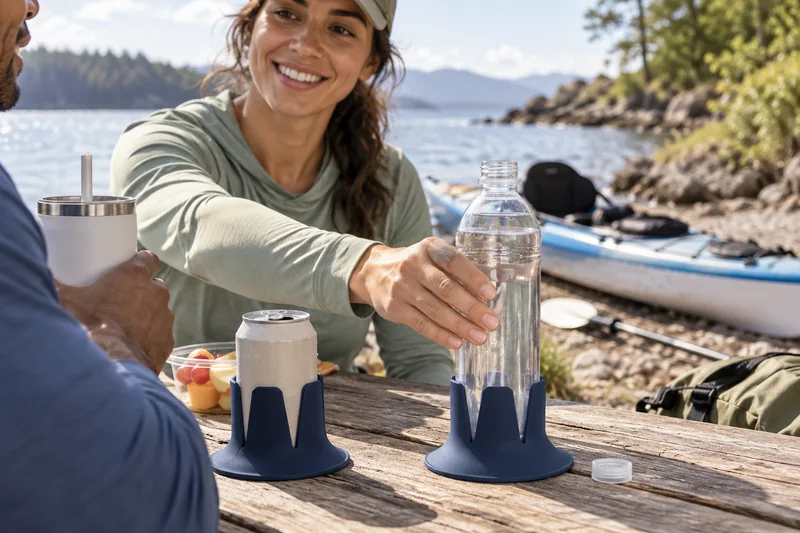
Steadi is that: a single piece of molded TPU, Shore 85A — not silicone — that a container sits down into. Flexible fins grip the bottom inch of the cup or bottle. The base is 5.2 inches across and it is fixed; it does not expand, contract or deform. Overall height is 2.8 inches, so it disappears into the footwell rather than standing up into the stroke arc.
The mechanism is one sentence: that fixed 5.2-inch base widens the base of support under the drink, so the container's centre of mass has to travel further horizontally before it passes outside that base — which means tipping takes a much larger tilt than the container's own footprint allows. The tack of the TPU resists sliding on wet polyethylene, which is the other half of what goes wrong on a kayak floor. It resists tipping and holds steady. It does not make anything untippable, and a direct hard knock still wins.
The limits, stated where you can see them:
It's molded in Orange, California, in small runs. Patent pending. There's a 90-day guarantee from delivery with free returns, and used is fine — which is the only sane way to sell something whose fit depends on what's in your cupboard.
Every fit argument in this category is really about the diameter of the bottom inch. Ounces tell you nothing.
Measure the base of the container you actually take out. Then check it against whatever you're considering, before the money moves.
Two minutes, on dry land, before the put-in. It settles more than an afternoon of reading reviews.
Sit-on-top with gear tracks (most fishing kayaks). Track holder, mounted in front of the seat rather than at the hip if you have the choice. Cleanest solution in the category. Consider a scupper mount only after you've measured your scuppers.
Sit-on-top without tracks (rec sit-on-tops, most rentals, most entry-level boats). The molded recess if your bottle actually sits in it; otherwise the footwell floor, with something under the container to widen its footprint. Adding a track is possible and means drilling; that's a legitimate choice, just not a small one.
Sit-inside recreational (Loon, Pungo, Tsunami, and their kin). Hardest case, least served by the market. No scuppers, no tankwell, no tracks, small deck. Realistic options: a coaming clip if your bottle is inside the 20 oz the Yakuzzi quotes, or the cockpit floor between your feet. Bow bungees are storage, not a drink spot.
Hobie or another boat with a factory rail. Use the rail. It's the interface you paid for.
The kayak-fishing convention is a good one and it applies to everything you add: on the water, untethered means eventually gone. Tracks, clamps and bolts hold gear to the boat. A base on the floor holds a drink to the base. Nothing on this list holds anything to the surface of the lake.
So the real question to settle in the driveway isn't which holder is best. It's which of these things you're willing to watch sink — and then keeping the rest low, inside the hull, and within reach.
Steadi is made by Steadi Labs and sold at steadilabs.com. One piece of TPU, molded in Orange, California. 90 days from delivery to decide, free returns, used is fine.
Can I put a cup holder on a kayak without drilling? Yes, if your boat has an interface: a gear track, a factory mount recess, a clampable rail like Hobie's H-Rail, a scupper of the right diameter, or (on a sit-inside) a cockpit coaming. All of the popular "no drilling required" holders assume one of those. If your boat has none of them, the no-drill options left are something that sits on the footwell floor, or nothing.
Do recreational kayaks have gear tracks? Usually not. Tracks and mount recesses are standard on fishing kayaks and increasingly common on higher-end sit-on-tops, but most recreational sit-insides and budget sit-on-tops ship with bare deck. Look for a lipped aluminum or molded channel before you buy any track accessory.
Will a suction cup holder work on a kayak deck? Poorly. Suction needs a perfectly smooth, non-porous, clean, dry surface — the guidance names acrylic windscreens and gelcoat consoles. A textured rotomolded polyethylene deck that is wet by design isn't that.
Where should the holder go — in front of the seat or beside my hip? In front, if you have the choice. A holder beside your hip sits inside the low-angle stroke arc on a narrow hull. Do ten dry strokes on land before you commit to a position.
Will a 32 oz Nalgene fit a kayak cup holder? Some. A wide-mouth Nalgene is 3.5 inches in diameter — worth measuring against a factory deck recess before assuming, and well past the 20 oz the Yakuzzi quotes for its coaming clip; for Steadi, measure the base of your own bottle against the current fit page. YakAttack's MultiMount cup holder names Nalgene bottles in its own copy.
Purchases go through steadilabs.com — the maker, directly.